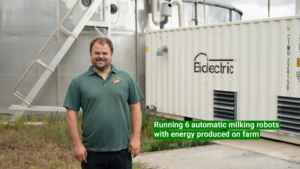
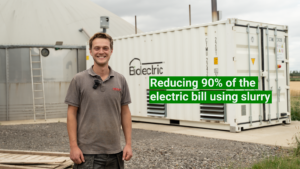
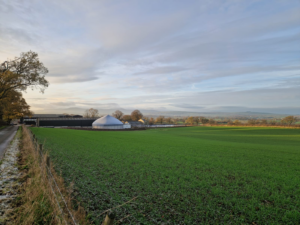
Askham Bryan College in York has turned its dairy slurry into a teaching tool and a source of renewable electricity with a 22 kW Biolectric farm-scale anaerobic digester. The project, nicknamed “The Electric Cow”, shows how further‑education farms can cut energy costs, reduce emissions and give students hands‑on experience with circular technology.
From waste problem to energy solution
Westfield Farm, the college’s on‑campus dairy, milks around 170 cows and operates robotic parlours for both commercial production and student training. Like many UK dairy farms, it sits in a nitrate‑vulnerable zone, which limits how much slurry can be spread on land.
Instead of seeing slurry purely as a waste stream, the estates and facilities team asked whether they could extract value from it. Full‑scale anaerobic digestion (AD) was too capital‑intensive for a college budget, so they opted for Biolectric’s micro‑AD concept: a compact, slurry‑only system designed for dairy farms.
Mark Gent, Director of Estates and Facilities, explains the logic:
“We recognised that we had a waste product in the slurry. We’re in a nitrogen‑controlled zone, so it’s not as easy as spreading it on our fields. But we had this waste product and thought, well, why don’t we look at whether we can produce electricity out of it and get something from it?”
Why Micro AD made sense for the college
The college compared options and concluded that a small‑scale, automated digester was the right fit:
- Affordable entry point compared with large AD plants
- Slurry‑only design tailored to dairy operations
- Low daily workload: the system runs in the background and needs only routine checks and periodic servicing
- Clear financial and carbon case: lower energy bills and reduced greenhouse‑gas emissions from stored slurry
Mark Gent summarises the decision:
“When we looked at the facts and figures, it seemed to be an obvious choice for us to invest in it, because not only is it saving carbon, but it’s obviously going to save money. And that’s a precious resource for a further‑education college. It’s an absolute win‑win.”

How the system works on site
The Biolectric installation at Askham Bryan follows a simple, circular flow:
- Slurry collection from the dairy buildings
- Anaerobic digestion in the Biolectric unit, where microbes break down organic matter without oxygen and produce biogas
- Combined heat and power (CHP) engine that converts biogas into electricity and heat
- Electricity used on site to power the dairy, including milking robots and other equipment
- Digestate returned to land as a nutrient‑rich biofertiliser, closing the loop
In practice, the system runs continuously with minimal intervention:
“Normally, day to day, it just works in the background. Our farm manager checks on it on a daily basis, checks on the system, and then every few weeks it requires a basic service. Other than that, we leave it alone and it gets on with it. It’s on 24/7 and produces electricity, saves money, and saves carbon.”
Educational impact: training the next generation
For Askham Bryan, the digester is as much about learning as it is about energy. The college uses the installation to:
- Demonstrate renewable energy technology in a real farm setting
- Teach students about waste management, biogas and nutrient cycling
- Show how automation and data support modern, low‑carbon farming
- Provide a live case study for courses in agriculture, engineering and environmental management
Mark Gent highlights the wider role of the college:
“We play a big part in that by teaching future farmers. Once they realise that and they embrace the technology, it’s going to change the face of dairy farming in the UK and across Europe. And it will cease to be the unsustainable practice that it currently is.”
Carbon, cost and reputation for dairy farming
British dairy farming has faced growing scrutiny over its carbon footprint and nutrient emissions. On‑farm micro‑AD offers a practical way to address both:
- Capturing methane from slurry that would otherwise escape to the atmosphere
- Displacing grid electricity with renewable, farm‑generated power
- Improving the sustainability story of milk production through visible, measurable action“British dairy farming hasn’t had great press of late from a sustainability and carbon point of view. So introducing systems like this—small‑scale, on‑farm systems that are more affordable than large‑scale AD plants—save the farmer money. Ultimately, it’s economical to do this from the farmer’s perspective.”
By redirecting greenhouse gases into energy, the college is helping to reshape the narrative around dairy:
“And it will certainly make a big dent in that, because we’re harnessing and using those gases and redirecting those gases so they’re not going into the atmosphere. It’s an obvious choice. If you’ve got a farm, if you’ve got a dairy farm, why wouldn’t you do it? Everything stacks up. Every stage of the process is a benefit to the farm and a benefit to the environment. So, just do it.”
Funding and strategic alignment
The project was supported by the York and North Yorkshire Net Zero Fund, led by the York and North Yorkshire Combined Authority with UK Government investment. This funding helped make the technology accessible for an educational institution and reinforced the region’s commitment to rural decarbonisation.
Askham Bryan College has also joined the Race to Zero campaign, committing to become a net‑zero organisation by 2050. The Biolectric digester is a visible milestone on that pathway, aligning operational savings with the college’s sustainability strategy.
What this means for other farms and colleges
Askham Bryan’s experience shows that micro‑AD is not only for large commercial units. It can work where:
- There is a steady supply of dairy slurry
- Energy costs are significant and volatile
- The operator wants a low‑maintenance, automated system
- There is an interest in teaching, demonstration or knowledge transfer
For Mark Gent, the conclusion is straightforward:
“We now have a circular system. We’ve got this waste product, which is no longer a waste product. We’re capturing the slurry, producing the gas, which in turn drives the engine, produces electricity, which then powers the dairy. So, very circular. So, in effect, our cows are powering the dairy.”